• About
  • Projects
  • Articles
  • Contact

julielivingstone

~ It isn't always about getting what you want. Sometimes it's about wanting what you've got.

julielivingstone

Category Archives: Uncategorized

Trollope and Wodehouse, compare and contrast

19 Wednesday Oct 2011

Posted by julielivingstone in Uncategorized

≈ Leave a comment

Tags

Anthony Trollope, books, Jeeves, novels, PG Wodehouse, reading, Wooster

Recently I’ve been reading, or more accurately listening on CD, to both Anthony Trollope and P.G. Wodehouse, two of my favourite authors. Until now I’d always thought of their works as belonging to totally different genres, but it dawned on me that there are pronounced similarities.

The particular Trollope novel I was listening to was one of his last, The Way We Live Now (BBC Audiobooks 2009, read by Timothy West).  It’s set in the mid 1870s. I followed this with Wodehouse’s Uncle Fred in the Springtime (BBC Audiobooks 2009, read by Jonathan Cecil), first published in 1939.

I’ve always envisaged the world of Wodehouse, Jeeves, Wooster et al, as being set in the 1920s rather than later, perhaps because the author stubbornly ignores any mention of the events in Europe during the 1930s, which led to the outbreak of war.

Wodehouse commented in an interview (reported here)  that he tried not to date his novels, as he was ‘bad at remembering things’.

If we allow Uncle Fred and his adventures to have taken place in the 1920s that gives only 50 years between the two works. They are remarkably similar, particularly considering that in the intervening time the world had been changed by the First World War.

Both deal with similar subjects, there is much talk of young men and their gambling debts, characters not being able to marry those they love because of financial and social considerations, elderly or powerful relatives who must be appeased. A young man, once he has agreed to become engaged to a girl, is a cad and a bounder if he breaks it off, and there is much plotting and scheming all round.

Obviously there are also differences, Trollope’s novel runs to 26 CDs and around 100 chapters, whereas Wodehouse’s is only 6 CDs. I think most people would consider Trollope’s work as satire, whereas Wodehouse’s is comedy with only the slightest edge to it.

There are similarities in the early lives and backgrounds of the two authors.

Trollope was born in 1815 and died in 1882. He went to Harrow and Winchester, but was unhappy at both. His father was ambitious for him, and had purchased a property in the right neighbourhood so that his son could go to Harrow as a day pupil. Due to his father’s later financial troubles, the whole family moved to Belgium in 1834 and lived off his mother’s earnings writing novels.

Trollope however returned to England after a short time and joined the General Post Office in London. Here he had some trouble with debt collectors, he started out owing his tailor 12 pounds, but the debt got passed to a moneylender and became 200 pounds. This experience is common to a number of characters in his books.

In 1841 Trollope took a post with the Post Office in Ireland, married, and started writing.

Wodehouse was born in 1881 in Guildford, Kent, although his parents at the time were living in Hong Kong where his father was a judge. Named Pelham Grenville, his great-grandfather was the second son of a baronet. The family returned to England when Wodehouse was three years old. He attended various boarding schools whilst his parents spent time abroad, and spent most of his holidays with various aunts. He completed his education at Dulwich College, where he edited the school magazine and took part in school theatricals. After school he went to work for the Hong Kong and Shanghai Bank. He was not much interested in banking, started writing in his spare time, and eventually left to become a journalist. In 1909 he travelled to America, where he married in 1914, and spent much of the remainder of his life overseas, dying in America in 1975.

Both authors were born into middle class families, educated at English public schools, neither particularly happily, went into middle class jobs which they didn’t particularly enjoy, started writing, and went to live overseas at around 30 years of age.

OK, I admit this is a very sketchy outline of the lives of these two men, and I have probably looked for the similarities and ignored the differences. I find it interesting though, and who knows, maybe one day the topic of deeper research. In the meantime I shall enjoy reading both of them, and try to find some of their books I haven’t already read.


Share this:

  • Share on X (Opens in new window) X
  • Share on Facebook (Opens in new window) Facebook
  • Email a link to a friend (Opens in new window) Email
Like Loading...

The Origin of the Phrases

12 Wednesday Oct 2011

Posted by julielivingstone in Uncategorized

≈ 5 Comments

Tags

language, origin of phrases, phrases, sayings, words

I’ve always been fascinated by different sayings and expressions, and how they come to be. Obviously I’m not alone in that judging by how many websites there are on the topic. The only frustrating part is often we will never really know how a particular phrase originated; we can only come up with a theory, which may or may not be correct.

For example, here in Australia we say ‘mad as a cut snake’. It’s fairly easy to guess the origin of that; a snake cut in half (a common if somewhat bloodthirsty way of dealing with the threat of a venomous snake too close for comfort – and done using a shovel or similar long handled implement, not a knife) would thrash around violently in its death throes.

Another Australian one that is less obvious is ‘flat out like a lizard drinking’. Lizards are pretty flat out when they are drinking, but then they are pretty flat out all the time, especially the ones with short legs.

Recently I was telling a friend that person A could ‘knock person B into a cocked hat so far as computer skills go’. Why do we say that, meaning the bit about hats, not computer skills? One theory is that it means being knocked out of shape, normal hats are round, like heads, but cocked hats are three cornered, so out of shape. This certainly seems plausible.

Thinking of this reminded me of the story about the British police helmet. (Do British bobbies still wear them, according to Wikipedia apparently yes they do.) Some wit looked at a British bobby and asked, ‘Does your head come all the way to the top of that helmet?’ Presumably he then ran quickly in the opposite direction.

Some of these expressions are very regional. I know that in England you will hear sayings in some places that you won’t hear in others. One I grew up with is ‘it’s black over Will’s mothers way’, meaning the sky is dark and it looks like rain. I Googled this, and came up with a few possible origins, none of them to my mind very satisfying. One theory is that the Will in question was William Shakespeare, and in that part of the country weather generally came from the direction of Stratford on Avon. In Essex the suggestion was William of Orange, who came from Holland, and that was the direction weather came from there.

It seems the saying is widespread in different parts of the country, so neither of these is very likely to be true.

Another possible suggestion is Will or Bill was a very common name, almost everybody would have known somebody called that, and therefore his mother and where she lived. This doesn’t seem right, other names were also common, why not Harry’s mother or John’s mother or Pete’s mother?

One which has me completely baffled is ‘I’ll go to the foot of our stairs’ to indicate surprise or amazement. I can think of no logical solution, even a far-fetched one.

These sayings all add colour to our language, although they are all quite old. I wonder if new ones are appearing, I’m sure they must be but at the moment I can’t think of any examples.

One point about the various websites discussing the origins of these phrases, I don’t think all of them are very reliable. Many of them have the same theories, and often the theories are only sent in by random contributors, not by anybody who has actually researched or studied the subject. I guess the same could be said about websites about almost anything. Here are a couple of the better ones in my opinion:

http://www.phrases.org.uk/meanings/index.html

http://www.wordorigins.org/index.php/more/3/

Another site I found which has heaps of links to language base resources is

http://www.yaelf.com/index.shtml

I didn’t have time to browse through a fraction of the stuff here – enter at your peril! I suspect it could be major time consumption. I won’t say time wasting, but it’s close. The site is a compilation of links to many other site loosely connected with English usage, and it’s the loose part that’s the problem. Some of the links are also obsolete.

I’ve tried blogging before, but never managed to maintain it, neither have I ever managed to write a journal for more than a week or so. This time I’ve set myself the task of posting every week, on or before Thursday, somewhere between 500 and 1000 words (more if I get really inspired). This means that sometimes the quality will be doubtful, but I hope to make a habit of writing, and train myself to write even when inspiration does not seem immediately forthcoming. This makes three weeks, but I think it takes longer than that to form a habit, I’d guess three months or so at least. I’ll review that after Christmas!

Share this:

  • Share on X (Opens in new window) X
  • Share on Facebook (Opens in new window) Facebook
  • Email a link to a friend (Opens in new window) Email
Like Loading...

Op-shop couture

06 Thursday Oct 2011

Posted by julielivingstone in Uncategorized

≈ Leave a comment

Tags

asymmetrical, clothes, design, Koos van den Akker, op-shop, quilting, reconstructed, recycled, TS14Plus, upcycled

I started looking for reconstructed and upcycled clothing on the net, and never dreamed how many hits I’d get. So many people are recycling clothing into all sorts of new fashions, and most of them are way more innovative than I would be. Try Googling reconstructed clothing, or recycled clothing, and you will find all sorts of inspiration. There are things to buy from other people, and ideas for things to make yourself.

I wanted a new outfit to wear to the editing workshop, and decided to create one myself out of op shop clothing. I’ve shopped op shops for years, first out of necessity when money was very tight, and more recently from not wanting to be a conspicuous consumer. It doesn’t hurt that it can still be way cheaper!

I went op shopping, and challenged myself to find what I needed in just one shop. Eventually I came away with one black top, one patterned, and one plain which picks up the colours of the pattern. I feel I ought to call the colour apricot, or salmon, but really I guess it’s orange! These are the tops.

The black one is going to be the base, I’m able to get into it but it’s a little tight, so I plan to cut it apart, and use the other two tops as decorative ways to put it back together again. Also I’ll lower the neck a bit, so I can wear another plain top underneath it, with sleeves for warmth. I really like some of the upmarket fashion labels I’ve seen in stores, with asymmetric clothes, and each garment having three or four different fabrics in it. Like these at TS14Plus clothes, and these Koos van den Akker designs from the Vogue pattern catalogue. I also did an image search on Google for Koos van den Akker, and came up with lots of ideas, although the flamboyance quotient of most of them is too high for me. Browsing through the images led me to several blogs of other admirers of his work, and eventually to the book, Couture Collage, which I am teetering on the brink of buying.

I’m hoping to end up with something inspired by these images, without the price tag. My base garments cost me $11.50 altogether.

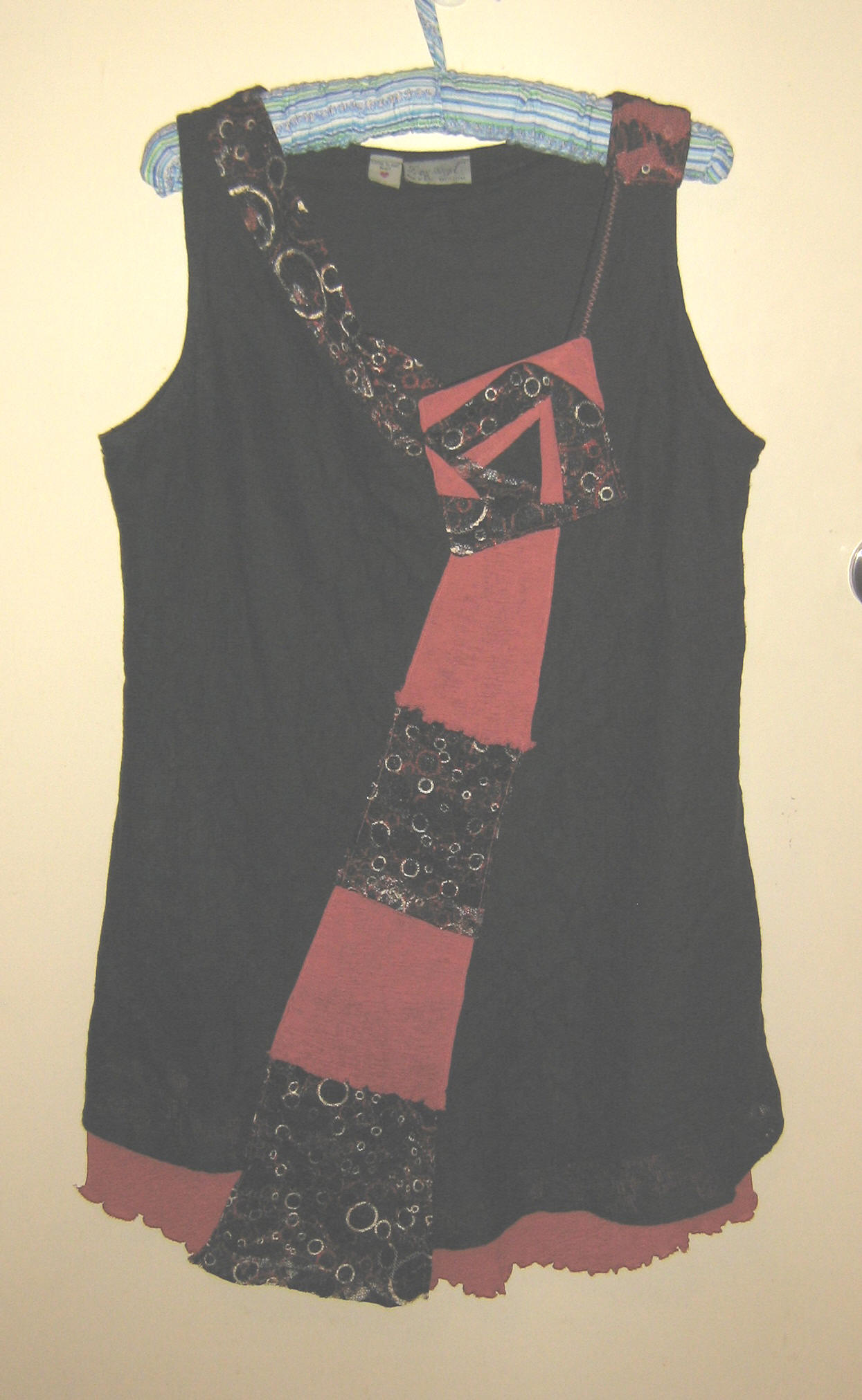
I started by cutting down the front of the black top, on a diagonal line. Then I cut a strip of the pattern fabric to finish the raw edge at the neck. I cut pieces of both fabrics and pieced them together to fill the gap between the two edges of the black top. Next step was to try it on, and I found that I had cut a little too far, and the V of the neckline was a bit low. I needed to construct something to put in to fill the space.

As often happens, inspiration came from nowhere in particular, or more accurately from one of my quilting books which was lying on the table. I decided to make a small patchwork square to stitch over the gap. I made a kind of uneven log cabin block, starting with a triangle instead of a square, but cut the finished block to a square, so it is completely asymmetrical. The finished square was a bit unruly in terms of having nice straight edges and corners, so I stitched it right sides together with a scrap of black lining, then turned it right side out. I think the technique is called ‘bagging out’ in the trade.

This little exercise highlighted how much easier it would be to do this kind of garment construction with a dress form. I’ve never had one, and never really felt the need, but when you are making the garment up as you go along I think it would be really useful to have something to put it on so you could see how it was shaping up, literally. I shall have to look out for a second hand one, as they are pretty expensive new. I know there are ways of making your own custom fit, but I don’t feel like investing the time at the moment, and mostly I’m not looking for a perfect fit in these garments.

Having fixed up the neckline I had only to stitch the lower part of the orange top around to the lining of the base black top. The orange top already had a nice lettuce edge on it, and because it was a wrap style with two layers at the front there was enough of the edge to go all the way around the hem of the black top. A bit of finishing off, and done, albeit at 7.30 on the morning of the workshop!

I was pleased with it. When I came home, however, the blonde dog was so pleased to see me that she jumped up and caught one of her claws in the slightly lacy black fabric, and made a hole in it. Next time I wear the top it will have either a contrast patch, or possibly a pocket added to it! It’s also occurred to me that maybe I should create some printed or woven labels to sew into my own constructions – another side project. If I’m going to keep posting pictures I need to make an effort to take better ones too.

Tags

Recycled reconstructed upcycled clothes Koos van den Akker Vogue TS 14 plus op shop design asymmetrical quilting

Share this:

  • Share on X (Opens in new window) X
  • Share on Facebook (Opens in new window) Facebook
  • Email a link to a friend (Opens in new window) Email
Like Loading...

Animals and water!

30 Friday Sep 2011

Posted by julielivingstone in Uncategorized

≈ Leave a comment

Tags

dogs, electric, fence, horses, labrador, property, water

Animals and water! They are the source of most of the problems in my life, I swear. I spend my time keeping one or other of them out of where they shouldn’t be, or in where they should be. Came home tonight to find the dog fence broken, and last night it was the electric fence in the horse paddock. I often think that my life would be so much simpler without them, but we can’t do without water, and I wouldn’t be without the animals. It’s so nice to come home at night to two dogs who are happy to see me, don’t ask anything more than to be fed and patted, and keep me company as much as they can.

I read recently a rather soppy saying that Golden Retrievers are the angels of the canine world, and although I do think it is soppy I can see the truth in it. I think Labradors qualify too though. They are always happy, have full confidence in the fact that they are the most loveable beings on earth, and never sulk or pout. Against that, they can be completely amoral, in that they don’t care about doing right or wrong, as they know they will always be forgiven anyway, so why bother? The Labrador creed is ‘Eat it first, ask questions after.’

I have two dogs, one a Golden Labrador, and the other a mongrel who I think is largely Flat Coated Retriever, but with some working dog mixed in, maybe Border Collie. They are both girls, one blonde (very), and the other black. The main disadvantage of this is we have both colours of dog hair. When we used to have two black dogs at least it was possible to wear black clothes without having them covered in noticeable dog hair all the time. Now if I wear black clothes the blonde hairs show up, and if I wear light coloured clothes then the black hairs show. Neutral grey is the only answer.

The black dog and her working dog ancestors are the reason for the dog fence, she is too prone to chasing things, and the normal fence designed for sheep and other livestock is no barrier to her. I have seen her run towards the fence, and jump straight through between the lines of wire with barely a hesitation. So we have a wireless fence, and she wears a collar with a receiver which gives her a small electric shock if she goes too close to the fence. There is debate about the humanity of these systems, but she’s a smart dog, and after a couple of times she doesn’t go close enough to get zapped. She knows exactly where she can and can’t go. It’s preferable in my view to having her get out on the road and maybe get hit by a car, or shot because she might go near somebody’s sheep.

I think I’m going to have to buy a fence tester to find the problem with the electric fence, the dog fence is easier to spot. I know from past experience that it is usually the joins that come apart, and knowing the weak spots it doesn’t usually take long to find which join. Then it’s just a matter of joining the wire up again. After a fair bit of trial and error I think just taping the two bare ends together with insulation tape is amongst the best and simplest methods. Most joiners give way under load, and are harder to re-join, but insulation tape is quick and easy. Plus I usually tape the join to the fence wire so it is easily visible for next time. I guess in an ideal world the fence would be so installed that there wasn’t a next time, but that is a little way down the track yet, and a fair way down my list of things to do, which gets longer instead of shorter. Probably most people are the same, at least I hope they are, except perhaps the super achievers.

I’ve been doing some research on electric fences, the livestock/horse variety, and found quite a bit of useful information. I now know that if you want to have more than about 500 metres of fence, you need to use high quality poly wire or tape, not the cheap versions, and for more than about 2000 metres you need to use galvanised wire. That’s harder to handle though, so although when I have everything set up it may be close to 2000 metres, I’m going to stick with poly wire and tape. I will set it up in two sections, only one needs to be turned on at a time, so it should be OK. There is a lot of guidance on a farm supplier’s website here, and also on a manufacturer’s site here.

That’s my weekend taken up anyway, getting the fence to work properly. Actually I should come clean and admit that I’m going to an editing workshop on Saturday, so I only have Sunday to do jobs around the property anyway.

I doubt this will be the last time I post on the subject of animals or water, or both, so watch this space!

Share this:

  • Share on X (Opens in new window) X
  • Share on Facebook (Opens in new window) Facebook
  • Email a link to a friend (Opens in new window) Email
Like Loading...

Hello world!

04 Sunday Sep 2011

Posted by julielivingstone in Uncategorized

≈ 2 Comments

Well, it is hello world! Or at least one very small corner of it. I’ve spent some time trying to get this blog to look the way I want it to, and to work as I’d like. Finally I think I am nearly enough there to make it public. It’s still a work in progress, but then that’s the essence of blogging, to update regularly. That’s where I’ve fallen down in the past, not being consistent or regular enough. I’m determined that this will be different, since I’m serious about being a writer.

The intention behind this blog is firstly to practice writing, and secondly to have a showcase for my work, and hopefully raise my profile so that when I start seriously wanting to write for publication, I will be a little bit known.

I’m currently taking an online course on writing magazine articles, which is what I intend to do, but I wonder about the future of magazines. Like books, will they be replaced by electronic versions? I read recently that for every magazine which closes at least one more starts up, which is positive. Unfortunately now I can’t remember where I read it, and can’t find it in the history of my browser either. More organisation is required! Also, I guess even electronic media need somebody to write for them, you can’t just keep recycling the same stuff all the time.

Well, here goes, I’m about to make this public. Wish me luck!


Share this:

  • Share on X (Opens in new window) X
  • Share on Facebook (Opens in new window) Facebook
  • Email a link to a friend (Opens in new window) Email
Like Loading...
Newer posts →

Back Pages

  • July 2018 (1)
  • November 2017 (1)
  • August 2017 (1)
  • June 2017 (2)
  • March 2017 (1)
  • October 2016 (1)
  • September 2016 (1)
  • August 2016 (2)
  • March 2016 (2)
  • February 2016 (2)
  • January 2016 (3)
  • August 2015 (1)
  • March 2015 (2)
  • February 2015 (1)
  • January 2015 (3)
  • December 2014 (2)
  • November 2014 (4)
  • April 2014 (2)
  • November 2013 (2)
  • October 2013 (1)
  • July 2013 (1)
  • June 2013 (2)
  • March 2013 (1)
  • February 2013 (2)
  • January 2013 (2)
  • December 2012 (3)
  • November 2012 (3)
  • October 2012 (4)
  • September 2012 (4)
  • August 2012 (1)
  • July 2012 (1)
  • May 2012 (1)
  • April 2012 (4)
  • March 2012 (2)
  • February 2012 (3)
  • January 2012 (3)
  • December 2011 (3)
  • November 2011 (5)
  • October 2011 (4)
  • September 2011 (2)

My Tags

Anthony Trollope Art Deco article ASG asymmetrical ATASDA Australian Sewing Guild blog blogging book books challenge Christmas clothes clouds colour commonplace book competition content craft creativity design dogs drawing electric embroidery fabric fashion illustration fence freelance Fremantle garden horses ideas inspiration in every issue Jeeves Koos van den Akker labrador language learning machine embroidery magazine Margaret Preston Mozilla novels op-shop origin of phrases pattern PG Wodehouse photography phrases project property quilting reading reconstructed recycled Roald Dahl sayings ScribeFire seo sewing skirt Threads magazine transfer dyes Tris Hussey TS14Plus upcycled water weather Wooster Wordpress words workshop writing

Create a free website or blog at WordPress.com.

Privacy & Cookies: This site uses cookies. By continuing to use this website, you agree to their use.
To find out more, including how to control cookies, see here: Cookie Policy
  • Subscribe Subscribed
    • julielivingstone
    • Join 35 other subscribers
    • Already have a WordPress.com account? Log in now.
    • julielivingstone
    • Subscribe Subscribed
    • Sign up
    • Log in
    • Report this content
    • View site in Reader
    • Manage subscriptions
    • Collapse this bar
 

Loading Comments...
 

    %d